Why helpers arrive late
Predators follow food. When aphids colonise a rose in spring, there is a lag — often one to three weeks — before adult ladybirds and hoverflies find the colony and lay eggs nearby. During that lag the aphids multiply visibly, and it is exactly then that many gardeners reach for a spray. The colony collapses, but so does the next generation of predators, and the cycle restarts with no one left to stop it.
If the plant is established and healthy, waiting is often the most effective strategy available. Check every few days. You are looking for eggs, larvae and the signs of predation described below.
Field note: a colony that suddenly shrinks, with empty skins and a few odd-looking larvae among the survivors, is almost always being eaten. Leave it alone.
Hoverflies: the wasp mimics
Adult hoverflies feed on nectar and pollen and are significant pollinators in their own right. Their striped abdomens imitate wasps, but they cannot sting. Look for a single pair of wings (wasps have two), large eyes that nearly meet on top of the head in males, short stubby antennae and the habit of hanging motionless in the air.
The larvae of many species, including the marmalade hoverfly, are legless, slug-like maggots with no obvious head, semi-transparent so that you can sometimes see their internal organs. They feed mostly at night, lifting aphids off the stem and draining them. A single larva may consume several hundred aphids before it pupates.
Ladybirds: learn the larvae
Adult ladybirds are familiar, but their larvae are frequently mistaken for pests. They are elongated, spiky and dark grey, usually with orange or cream markings — some gardeners describe them as tiny alligators. Pupae look like small orange-and-black blisters fixed to leaves.
The harlequin ladybird, Harmonia axyridis, first recorded in Britain in 2004, is highly variable in colour and spot number and competes with native species. It still eats aphids, and there is no practical reason to kill it in a garden setting; recording sightings for national surveys is more useful.
"The adult beetle gets the credit, but the larva does much of the eating."
Lacewings: the aphid lions
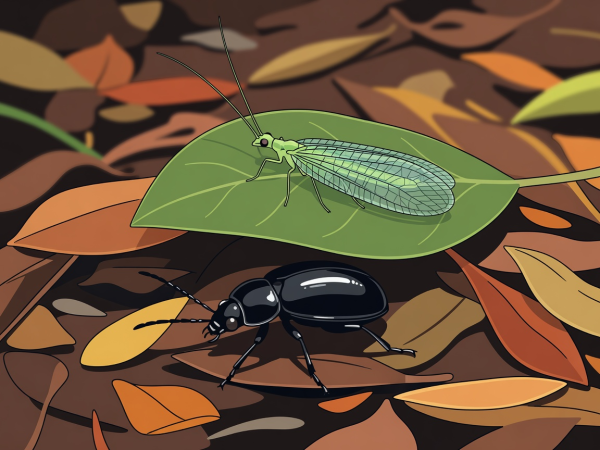
Green lacewing adults are night-flying insects with golden eyes and finely netted wings. Their larvae are flattened and tapering, with prominent sickle-shaped jaws. Some species cover themselves in debris, including the empty skins of their prey. Eggs are laid singly on fine stalks, which look like tiny pins standing on a leaf.
Beetles, centipedes and the night shift
Ground beetles and rove beetles hunt at soil level after dark, taking slug eggs, small slugs, cutworms and fly larvae. Centipedes — fast, flattened, one pair of legs per segment — are predators, unlike the slower, rounded millipedes that feed mainly on decaying matter. A log pile, stones or an unmown margin gives all of them daytime shelter.
Parasitoid wasps: evidence over sightings
You will rarely notice the tiny wasps of the genus Aphidius, but you can find their work. A parasitised aphid swells into a rigid, bronze or pale "mummy". When the new wasp emerges it leaves a neat round hole. Under glass, Encarsia formosa turns whitefly scales black — the same principle, used deliberately as a commercial biological control.
Keeping beneficials around
- Tolerate small early outbreaks so that predators have something to breed on.
- Grow open, flat flowers such as fennel, yarrow and wild carrot for adult hoverflies and parasitoids.
- Leave hollow stems and leaf litter over winter where possible.
- Avoid broad-spectrum insecticides, which kill predators as readily as pests.
- Add water: a shallow dish with stones, or a small wildlife pond for frogs and toads.
Doug Tallamy's Bringing Nature Home and Dave Goulson's The Garden Jungle both make the wider case: a garden that feeds a diversity of insects tends to regulate itself. For local recording, iNaturalist and national schemes welcome photographs.