Who pollinates a garden?
Honeybees are managed livestock, kept in hives. In most gardens, the bulk of pollination is done by wild insects: dozens of bumblebee and solitary bee species, hoverflies, butterflies, moths, beetles and even some wasps. Each group has its own flower preferences and life cycle, so a garden that suits only one kind leaves the others hungry.
Identifying bees to species can be genuinely difficult. Several bumblebees share near-identical colour patterns, and worn individuals lose their colour. It is perfectly reasonable to record "white-tailed bumblebee group" rather than force a species name. Expert recorders do the same.
Bumblebees and the spring gap
Queen bumblebees emerge from hibernation in late winter and early spring, hungry and needing nectar and pollen fast. Early flowers — crocus, lungwort (Pulmonaria), winter heather, willow catkins, flowering currant — can make a real difference. In milder areas, buff-tailed bumblebees now sometimes forage through winter on garden plants such as mahonia.
"A continuous supply of flowers across the year matters more than one spectacular month."
Solitary bees: mostly underground
Around three-quarters of solitary bee species in Britain nest in the ground, digging burrows in sunny, sparsely vegetated soil. Lawns, path edges and south-facing banks are prime sites. A patch you leave unmulched and unplanted may be the most useful habitat in your garden.
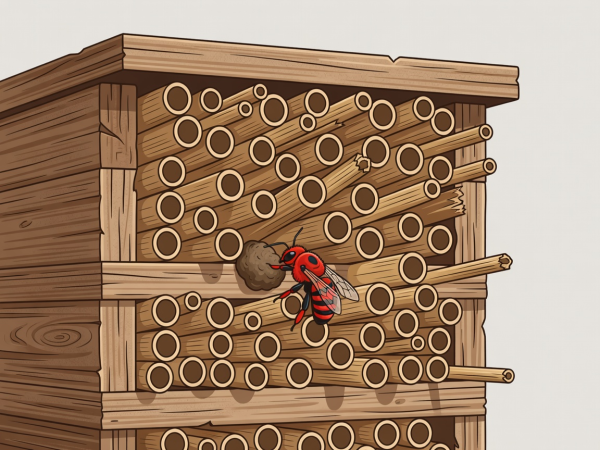
Cavity-nesting species such as mason and leafcutter bees will use bee hotels. Choose ones with smooth tubes of varied diameter, place them in full sun at about head height, and replace or clean tubes every couple of years to limit parasites and mould. Cheap hotels with rough bamboo or open backs often do more harm than good.
Hoverflies, butterflies and moths
Hoverflies need open, shallow flowers because their mouthparts are short: think of umbellifers, daisies, ivy and single roses. Butterflies need nectar plants for adults and specific food plants for caterpillars — nettles for peacock and small tortoiseshell, holly and ivy for holly blue. Moths are among the most important night pollinators, and many caterpillars that gardeners see are moth larvae doing very little harm.
Habitat checklist
- Aim for something in flower from February to November.
- Prefer single over double flowers; doubles often hold little nectar or pollen.
- Leave some lawn uncut to let clover, self-heal and dandelion flower.
- Keep a sunny patch of bare soil for mining bees.
- Leave hollow stems standing until spring.
- Provide shallow water with landing stones.
- Light less at night; outdoor lighting disrupts moths.
Chemicals and flowers
Do not apply any pesticide to plants in flower, including soaps, oils and plant-derived products, which can harm insects on contact. The European Union restricted outdoor uses of three neonicotinoid insecticides in 2018 because of their effects on bees; rules differ elsewhere, so check what applies in your country and read every label.
Count and contribute
Citizen science turns observation into evidence. The UK Pollinator Monitoring Scheme uses ten-minute Flower-Insect Timed (FIT) counts; Butterfly Conservation runs the Big Butterfly Count each summer; the Bumblebee Conservation Trust coordinates BeeWalk transects; and in North America the Great Sunflower Project and the Xerces Society offer similar opportunities.